3.02.2008

Darn Chores!


This little Vietnamese boy's face says it all. Darn Chores!
Living in the Mekong Delta, the people in this southernmost region of Vietnam seem to spend more of their life on or in the water than on dry land. This is no tropical paradise however, in fact, it's one of the poorest regions in Vietnam where the people are all but cut off from the rest of the country by the Nine Dragons, which is how the Vietnamese refer to the nine major rivers that the Mekong splits into before reaching the South China Sea. Obviously, the most readily available source of protein in this region is fish, which is where this boys daily chore comes in. What initially appears to be every little boy's dream of playing in the mud, upon closer inspection shows that, he is in fact collecting the daily catch along the banks of the river. Due to the delta's proximity to the sea, the river actually experiences the ebb and flow tides of the ocean. Generations of Delta living have taught the local families to use this natural phenomenon to their advantage. By lining nets along the banks of the river, which are under water during hide tide, fish are caught by getting stranded in the nets as the water recedes. The obvious disadvantages of this technique are that there is a certain amount of luck involved as well as the fact that someone has the rather messy task of going waist deep into the mud to collect the bounty.
On a personal note, I promise to never again complain about having to empty the dishwasher or take out the trash!

9.20.2007

Angkor Wat at "Golden Hour"

As the largest religious structure ever built and proprietor of some of the world’s most magnificent stone carvings, Angkor Wat is considered by many to be one of the greatest architectural achievements in human history. Divided into the three main levels of the Hindu cosmos, it features an 800 meter long gallery of magnificent bas-reliefs depicting epic stories from Hindu mythology, four stone block swimming pools and five central towers. These towers depict the peaks of Mount Meru, home of the gods and the center of the Hindu universe. At over 180 feet high, they can not only be seen from the town of Siem Reap six kilometers away, they can also be seen all over the country as the main symbol on the Cambodian flag.
The Wat is the crowning achievement of the Khmer civilization which, in it’s prime, ruled over most of Southeast Asia. It was commissioned by and built for the god-king, Suryavarman II who was worshipped as an incarnation of the protector god Vishnu. The only temple in the Khmer empire facing West into the setting sun, a symbol of death in Hinduism, it is an accepted belief that it was built as a mausoleum for Suryavarman II. The fact that it took 50,000 artist and laborers nearly 40 years to complete is a testament to the Khmers power, wealth and devotion.
To make this photograph showing all five towers, I walked off of the main causeway and joined the cattle that still graze in the fields contained within Angkor’s vast complex. Taken just before sunset, it illustrates why we photographers refer to this time of day as “golden hour”. Taken at any other time of the day, the wat wouldn’t have this beautiful golden color (a reflection of the sunset behind me), but rather it’s natural stone-grey color.

8.17.2007

Last Light

I had spent the afternoon exploring the Khumbu Glacier, which serves as the base camp for Everest summit expeditions, when I realized I had better start heading back to my own base camp before I was stuck on a living glacier in the dark. I was walking along the moraine of the glacier when, about 30 minutes after the sun had already set, I looked back for one more view of the world's highest peak. This is what I saw. All of Everest's neighbors, some top five peaks in their own right, were already in the shadows while the golden light of the sun was still beaming off of Everest's Southwestern face. A beautiful image as well as proof that Everest really is the top of the world.

8.13.2006

Mittens

Perhaps no other local illustrates the rugged American Southwest better than Monument Valley. This must be exactly how the famous Hollywood director John Ford felt when he first discovered this magical landscape in the mid-thirties, and is the reason why he chose to shoot several of his blockbuster westerns here including, Stagecoach in 1939 and How The West Was Won in 1962. Although it still receives relatively few tourists compared to other parks in the region such as Grand Canyon National Park in Arizona or Zion and Bryce canyons in Utah, most people still find it familiar. This is no doubt due to the countless advertising campaigns that have featured the monuments as the backdrop for marketing their rugged image. Toyota trucks and even the United States Marine Corps have used the scenery, but nobody seems to spend more time here than the Marlboro Man. Yes, that fictional cowboy the Marlboro Man is the reason why most people in the world have seen pictures of Monument Valley, whether they realize it or not. In fact, I have noticed billboards in Kathmandu and posters in Tokyo featuring Monument Valley's vistas and always point out to people, "Hey,that's where I'm from". Actually, the only people that can really claim to be "from" Monument Valley are the people of the Navajo Nation as Monument Valley sits entirely inside the borders of the Navajo Indian Reservation, the largest such reservation in the United States. For centuries the Navajo have been ranching and farming this land and consider many of the monuments to be sacred.
Just South of the border with Utah, these are probably the most famous monuments in the valley and together they are known as The Mittens. No matter how many times you go to Monument Valley, they never cease to inspire awe with their shear size and perfectly eroded shapes of a left and right mitten. I chose this composition because I felt the beautifully striated boulders in the foreground not only lead the viewers eyes nicely into the photograph but also added the depth I needed in such a vast landscape shot. Recently, I came across an old photo of the East Mitten taken decades ago by Ansel Adams in which his tripod must have been in the same exact spot as mine. Had I seen that photograph ahead of time, I probably never would have taken this shot because the challenge for any professional photographer in a place as photographed as Monument Valley is to get a unique perspective of a familiar place. However, in this case I felt very proud and honored. Not only did I stand where the legend once stood but, for that one photograph, I also experienced the same creative vision as him.

8.05.2006

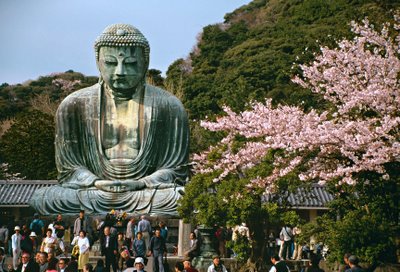
The Daibutsu and a Sakura Tree


This photograph shows the "Daibutsu" (Giant Buddha) silently meditating in Kamakura, Japan as he has for over 750 years. It was commissioned by Yoritomo Minamoto, Japan's first Shogun, to celebrate his victory over the archrival Taira clan. Cast in bronze and weighing in at 850 tons, it originally sat inside a great hall which was washed away by a tsunami in 1495. Fortunately, being exposed to the elements for over 500 years has only added character and tranquility to the Buddha's likeness.
Sakuras (Cherry Blossom Trees), like the one in the foreground, are revered by the Japanese for their fleeting beauty as their gorgeous blossoms last for only a week or two. Due to this transitory nature of sakura blossoms and the inclement climate of the Eastern coast, it actually took three trips to Kamakura to capture this iconic Japanese image.
Whereas, I usually go to great lengths to avoid putting random groups of people into my landscape photographs, in this particular case I needed them to show scale. I also like how they naturally illustrate the reverence they still have for their "Daibutsu".

7.23.2006

Two Toothed Grin


There are two distinct types of images in travel photography; those that you plan for, usually in the form of beautiful landscape photographs, and those which come about serendipitously as you wander the streets with your camera and a keen eye. This is a great example of the latter.
I made this portrait in the charming town of Hoi An which is draped with the influence of all the seafaring cultures of both Asia and Europe that have been trading here for over four centuries. I was actually walking back to the old French part of town to photograph some of the buildings and architecture I had seen the day before when the lighting wasn't ideal. I took a shortcut through the main market, figuring Asian markets are always a good source of those afore mentioned serendipitous moments. Wait a minute, can you plan for serendipitous moments? Ah yes, the middle path, Buddha would be proud! Anyway, as I came out the other side of the market I saw this old woman walking towards the market on the other side of the street. I knew instantly, I had to take her portrait. I approached her with a smile and my best attempt at hello in Vietnamese. I quickly found out that we weren't going to understand a single syllable of what each other was saying. Given her age in Vietnam, it very likely she actually speaks three or more languages as many of the older generations can speak, French, Chinese or even Russian. Unfortunately, I am no more familiar with those languages than I am with Vietnamese. Fortunately however, I also found out that it really didn't matter. She was one of the sweetest people I met during my two months in Vietnam. We must have had a twenty minute conversation on that sidewalk. A conversation of meaningless words, yet an incredible amount of understanding and laughter. I was definitely intrigued by her. After all, she has lived through several wars, been colonized, seen governments come and go and probably walked to this market everyday for the past sixty or seventy years. Certainly a tough life by many standards, yet she was every bit as jovial and full of pride as this photograph would indicate. If only those wrinkles could speak, I'm sure there is an amazing story for each one of them. If only I could understand them if they could!

7.09.2006

La Corona de la Iglesia

This is the crown or "corona" that tops the beautiful and historical Cathedral of Our Lady of Guadalupe in the old quarter of Puerto Vallarta. I wanted a silhouetted shot of the crown with the red hued sunset and ocean as a backdrop. This turned out to be far more of a logistical challenge than an artistic one. I walked up the steep cobblestone road to get behind the church and did my best to explain to the locals what I had in mind. After about thirty minutes of entertaining the locals with my attempts at Spanish and futilely looking for a clear view, I was beginning to think there was a good reason why I hadn't seen this image on any postcards. Finally, a local family understood what I was out for and introduced me to their neighbor, whom they said had the best view of the church in town. He ended up inviting me up to his rooftop where I took a few frames, drank a few cervezas and enjoyed some great, if not broken conversation with a local family. Once again, my camera opens doors that no key ever could! It is this symbiotic relationship between travel and photography that stirs my passion for this career.

4.22.2006

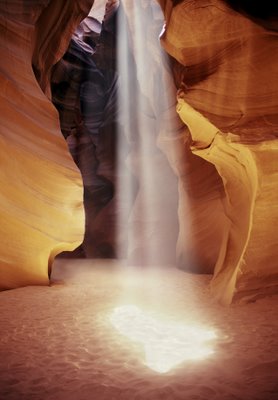
Beam Me Up

This is an example of an image that I planned for extensively. Having been to this location months prior, I vowed to come back at the perfect time to get this magical shot. That “perfect time” only occurs around noon in the summertime when a crack in the narrow walls above cast this perfect beam of sunshine on the sandy ground. A tripod and a carefully timed exposure helped capture, what I consider the world’s most beautiful and natural sundial.

4.15.2006

Queen of Skin Care


I was commissioned to take some product shots for the soon to be released skin care line called Skin Cubed. I love shot not only for it's aesthetic value, but also because it serves as a example to me that it doesn't take a fancy studio or expensive equipment to make great photographs.
To create this shot I used items such as a cookie sheet, tinfoil, pitcher of water and a turkey baster, items more associated with a kitchen than a photography studio!
Perhaps more than any photo I have ever taken, this shot reminds me that it's all about being able to think creatively and posses the technical knowledge to create your vision. I believe that really good photographers are among the rare group of people that can combine these two, sometimes opposing skills, to create memorable images. Some people think pragmatically, others artistically, photography often requires you to do both. As I usually take this "middle path" it's no wonder I found my calling in photography.

3.17.2006

Khlong Damnoen Saduak Floating Market

Taken from a bridge that spans the “khlong” (canal) at the heart of the market; this shot offers a glimpse of how transportation and commerce took place in Bangkok when it was still known as the “Venice of the Orient”. These days, most of the khlongs in the capital have been replaced by congested streets. However, it is still possible to find active floating markets all over the kingdom, such as this one in Ratchaburi Province.