
1.25.2013


9.15.2012

5.05.2012


2.01.2012
7.18.2010
Art of Seeing 2010

Kevin's photograph, Cover Girl is being featured in the 2010 edition of The Art of Seeing an annual collectors book featuring some of the top creative photography from around the world. This is the second such honor for Kevin after his black and white image, Curious Mustang was featured in the 2007 edition. The book is published by Alcove Books who also publish the respected American Art Collector annual which featured Kevin's, Beam Me Up back in 2006.
Here again, is Kevin's story behind this evocative image:
I made this photograph of a hilltribe (a.k.a. montagnard in Vietnam) girl at the outdoor market in Bac Ha Vietnam. Although only 110 kilometers (68 miles) from Sapa, the trip took over five hours in the old Russian built 4X4 I rented. Getting there was truly half the fun! The remoteness of Bac Ha also makes it a photographer's paradise. Upon arrival at the market, I found no tourists and had the bustling collage of the ten different hilltribes that live, farm and raise livestock in the surrounding hills to myself. As much as it is obviously a place to buy, sell and trade their goods, the market also serves as an important social gathering place to all of the tribes in the region.
This young girl, as with all of the women at the market, uses this large social gathering to showcase her most elaborate handmade headdress and silver jewelry. Individuals take great pride in their attire because it reflects not only the tribe the belong to, but also their families social status and wealth. Just as I had framed her gnawing on her favorite market treat, a stalk of sugarcane, she took a break and glanced perfectly into my lens providing me with this image and the knowledge that having a sweet tooth is truly cross-cultural.
5.09.2010
Pink Lotus

Even though I've never specialized in the genre of botanicals, and it's never been my style to carry around a spray bottle, I know enough about shooting flowers to know that they always look better after a rain shower or nice morning dew. Well. as so often happens on the road I had a serendipitous moment. I was having lunch with my favorite travel partner (my camera) one rainy afternoon inside the beautiful grounds of the Pura Taman Saraswati Temple in Ubud, Bali. In between the patio I was dining on and the front entrance to the temple was a lotus pond spanned by a bridge made from the same brick and sandstone as the temple. I knew it would be the perfect vantage point for some great shots of the lotus blossoms. Having a few years worth of experience with tropical showers in Southeast Asia, I figured the deluge wouldn’t last long. I was right and before I had even finished my iced coffee the sun was back out once again turning the forests of Ubud into a giant steam room. Nature having done most of the work for me, it was simply a matter of finding the most perfect blossom, setting up my tripod, getting the right readings and... snap!
For centuries, the lotus has been the spiritual flower of Buddhist and Hindu cultures all across southern Asia. Buddha himself is often depicted sitting in a meditative pose on a lotus flower and when Thai people greet each other or "wai" they press their hands together, slightly cupped in the shape of a lotus bud in front of their heart. It not only has religious significance but not unlike sakura blossoms in Japan, it also has a philosophical one. The great Eastern philosophers have often used the lotus as a metaphor for it's ability to grow something so beautiful out of such muddy, stagnant water. Indeed, I find myself looking at this photograph I made to remind me that sometimes the we have within ourselves comes out during the most challenging of times.
4.08.2010
AWIF Photo of Mt. Ama Dablam Featured in April Issue of Popular Photography Magazine
My photograph of Ama Dablam is one of the featured photographs for Popular Photography's feature article, Top Professional Photographer's Favorite Destinations. On newsstands now!

3.01.2010


2.07.2010
Lanterns In Gion
 This photograph was one of the last frames I shot during a culturally rich and photographically prodigious week I spent in Kyoto, Japan. Walking back to my "minshuku" (Japanese bed and breakfast) after a long day of sightseeing, strolling and of course shooting, I came across this town square with rows and rows of traditional Japanese hanging lanterns. Rather than having to brainstorm ideas, I had compositions and exposure values flooding my head before I could even fully extract the legs of my tripod. This was going to be a fun session! After all, there are so many different aspects of photography to get creative with here. The inner glow of the lanterns being the only light source enabled me to play with some really long exposures, the depth and length of the rows allowed for countless composition options and the Shogun Era "kamon" (family crests) and Japanese characters made perfect visuals for some great "sense of place" photographs.
For this exposure, I decided to place three rows of lanterns running lengthwise and diagonally through the frame. This really leads the viewers eye through the entire photograph, starting with the large, sharply focused lanterns in the foreground on the left hand side of the frame and moving towards the distant, softer ones in the right hand side of the frame. Everything else being equal, I find it usually best to move through a frame from left to right as this is the direction most people read and therefore find the most natural.
Taking this principle to a whole new level and applying it to fine-art, we created this triptych which really does seem to light up a room, even if it doesn't do so literally.

1.31.2010
Two Geishas
 This photograph has special meaning for me. Not only has it become one of my most popular portraits, it also serves as a reminder of several core principals that have helped me over the years. That is, persistence and stepping outside of your comfort zone can sometimes lead to great luck.
As the name would imply, I took this photograph in the Gion district of Kyoto. In its prime, Gion was the most exclusive "hanamachi" (geisha community) in all of Japan. In fact, working in Gion was so prestigious that the geisha of Gion were referred to more respectfully as "geiko" or a woman of art. Nowadays, Gion is famous for being one of the few "hanamachi" left in Japan. Due to the rapid development, modernization and globalization of Japan, ancient cultural traditions and art forms have suffered atrophy. This, coupled with the fact that very few girls are willing to make the sacrifices necessary to carry on this unique tradition and it seems to be only a matter of time before geisha slip into historical lore like the the samurai.
I spent hours each afternoon in Gion strolling up and down the narrow streets lined with "ochaya" (tea houses), hoping to catch a glimpse of the famously illusive geisha. After two days of shooting everything geisha except, well, a geisha, I was beginning to think that they were just a figment created by the Japanese Ministry of Culture and Tourism. Then, in the late afternoon of my last day in Kyoto, a chance encounter of a photographer's dreams. As a rounded a corner I saw them, two of them! I walked slowly behind them taking some environmental and detail shots as they shuffled down the street, careful not to disturb the harmony. Once they sensed my presence, stopped and turned towards me I thought my ideal photo shoot was over for sure. After all, I have no idea how geisha feel about being photographed and even I felt a bit uncomfortable, like some kind of geisha paparazzi. Realizing this was my only opportunity, I smiled, showed them my camera and non-verbally asked them for a quick shot. Surprisingly, they giggled at each other and almost seemed flattered by my eagerness. I worked quickly around them, instinctively finding the best possible light and background and then took two frames before giving them a deep bow and letting them once again slowly shuffle towards their destination. "Arigato goziamasu" (thank you very much) indeed!
1.24.2010
Silhouetted Seaweed Farmer

I made this photograph from the beach on Nusa Lembongan, a small island in the Badung Strait between the popular islands of Bali and Lombok in Indonesia. As you may suspect, the 7,000 or so inhabitants of this laid-back island depend almost exclusively on the ocean for their livelihood. Sitting like a speed bump in the deep Badung Strait between the Pacific and Indian Oceans has some distinct advantages. The shallow coral reefs surrounding the island provide not only protection from the strong currents, but also most of the locals diet. What's more, the entire economy of Nusa Lembongan relies on the reefs as they also allow for the cultivation of seaweed, not to mention the sea-loving tourists there for the world class surfing and scuba diving.
As I was photographing some of the farmers carrying their daily harvest of seaweed onto the beach, I happen to look up and catch inspiration. I saw this one last seaweed farmer guiding his flat bottomed skiff across the horizon. Knowing he would soon be crossing in front of the golden sunset, I framed my shot and waited for him to pass through so I could catch a perfect silhouette of him.
1.17.2010
Little Emperor

China's draconian one-child policy, first instituted in 1979 in an effort to curb the population growth, is now revealing some startling side-effects. As you may imagine in a country where almost all of the children are an "only child", there tends to be a severe amount of doting parents who spoil their children incessantly. This is especially true for boys. So much so in fact, they have given these children the nickname, "little emperors".
I first noticed this adorable little emperor as he was squatting in the grass going pee through a slit in the crotch of his pants. Only later did I realize that this is the common practice in China. Rather than using diapers, parents simply cut a slit in their children's trousers so they can squat outside and go whenever they need to. The only thing more out of the ordinary to my occidental eyes than seeing toddlers relieve themselves in the middle of a city park, is the sight of their parents who often stroll the park in their pajamas! Anyway, I interrogatively gestured to his parents if it would be o.k. for me to take his picture. Of course they were honored and proud as peacocks. He was far more interested in playing peek-a-boo with me than having his portrait taken, but as you can see, I couldn't have asked for a cuter, more natural pose.
They say children are one of the most challenging subjects to shoot because you can't give them direction as you would an adult. I however, disagree. You simply have to think the way the do, get down to their level, play a bit and shoot the action.
10.04.2009
Christ Watching Over The "Marvelous City"

I can vividly remember as a child seeing a photo similar to this in an elementary school geography book and thinking, someday I must see this in person. It is one of my earliest memories of experiencing wanderlust, a diagnosis that would become a driving force throughout my life. Only later as an adult did I come to find out that this is also the birthplace of Bossa Nova, the bikini, and of course, the world's largest party. It is also home to over seven million Cariocas, as the locals call themselves, a colorful mix of some of the most beautiful people in the world all packed into the most beautiful urban setting on the planet, Rio de Janeiro.
The geography and people of Rio have created a unique urban sprawl, whereby some of the wealthiest people in Brazil live next to or even beneath some of the poorest. The poor have taken to illegally building favelas or shanty towns on any available space that clings to or straddles Rio's magnificent mountains. The irony of course, is that it's the people of the favelas that have the most magnificent views of their Cidade Maravilhosa or Marvelous City. Constantly watching over this marvelous city and all who inhabit it is the enormous statue of Cristo Redentor, Christ the Redeemer. Perched on the tip of Corcovado, or Hunchback mountain at 2,329 feet above the city, it can be seen from just about anywhere and offers a breathtaking view from it's base.
Even though this image is on postcards all over the city, I wanted to fulfill my childhood vision to see it and photograph it for myself. After experiencing a week of Carnaval and a month in Rio I hadn't had the opportunity to get my photo on a clear day. Miraculously, on my last morning in Rio I woke up to this heavenly, clear, blue sky. Risking missing my flight, I raced to the helicopter pad and fulfilled my vision.
9.20.2009
Sunflowers In Dalat
 Admittedly, this photo doesn't fit my usual style of making photographs that "promote global awareness and cultural understanding". However, being a travel and documentary photographer it does give a nice "sense of place". North Dakota? South of France? No, in this case, that "place" is a kitschy hotel that was formerly a French Colonial Governor's mansion or something like that in Dalat, Vietnam. O.K., I must admit, I don't remember the actual building so much, due to the fact that it was not nearly as impressive as the little pamphlet the ministry of tourism gave me. The garden path that I discovered leaving the mansion however, was worth putting of my afternoon glass of Vietnamese drip coffee for another half hour. Just barely though. I'm telling you, that stuff is sheer ambrosia!
Alright, so "sense of place" did come into play. I mean, who knew they had massive sunflowers in Vietnam? However, I must admit the main reason I took this photograph is because I knew that both the colors and sunny disposition of these giant sunflowers would create a fantastic print that simply lights-up a room.
Over time, the popularity of this print has reaffirmed a couple of things to me. First, to trust my instincts. If a scene jumps out at me for any reason, shoot it! It doesn't always have to fit into a story, theme, etc. Secondly, never underestimate how much women love sunflowers!
9.13.2009
Paying Homage
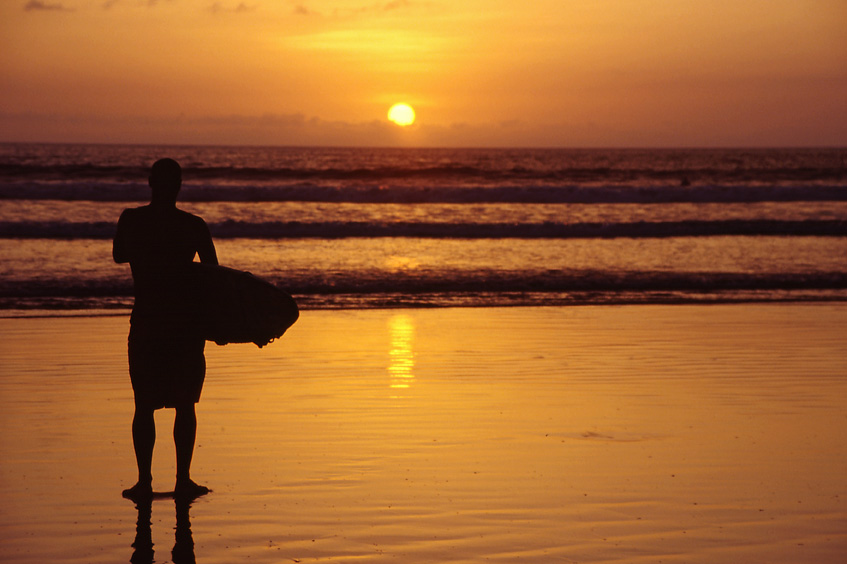
Well, Labor Day has come and gone and with it another Summer. Even though the mercury is still in realm of triple digits here in Phoenix, it is heading downward, as is the sun earlier and earlier each day. Kids are back in school, vacations are now memories and we'll be celebrating the harvest before you know it. O.K. most of us have never harvested food in our lives, but we'll feast and celebrate anyway! At any rate, like it or not, Summer is over and therefore, I thought I finish it off with an "Endless Summer" inspired Photo of the Week. Enjoy! Also, if it helps, refer back in a couple of months when you are freezing and tired of scrapping the ice off of your windshield!
A few years ago I traveled to Bali for a month with the mission of trying to capture on film what it is that makes this relatively small island stand out, despite being one of 17,508 islands in the Indonesian archipelago. I found that it isn't just one thing, but rather the sum of it's unique and exotic culture, stunning vistas imbued with spiritual significance and range of activities that inspire travelers of all types to seek out their own paradise here.
With rumors of long reef breaks and consistent swells, surfers were among the first hardcore travelers to arrive and discover this, "Island of the Gods". Soon thereafter, names like Kuta, Ulu Watu and Dreamland lured the faithful from around the globe. Today, all along the Southern coast, motorbikes are outfitted with surfboard racks and the convenient stores have designated "surfboard parking " areas in an effort to accommodate those who come to conquer these breaks. Wanting to learn more about this subculture of the island, I rented a long board for a week and even enrolled in a weekend surf school. In class I learned about everything from duck-dives to rip-tides, however, the most valuable lessons I learned were the ones that nobody can teach you. I discovered that surfing is equal parts meditation and exertion. Moments of serene contentment followed by vigorous contests against the ocean's perpetual treadmill of waves. Much more than just a sport, it's about being in harmony with nature in her most natural environment.
Inspired by my newfound wisdom, I headed down to Kuta Beach to take on the challenge of capturing this essence in a still frame. I decided the best way to accomplish this would be to isolate a lone surfer set against the ocean and the setting sun. I have always liked working with silhouettes of people because the sense of anonymity lends itself to the feeling of "everyman" or in this case, every surfer. I tracked this local, who seemed to be particularly "in focus" as he came in from the days last set. As I framed him in the viewfinder and waited, the magic of the medium happened. Before turning his back and calling it a day at the beach, he looked back at the ocean for a moment of thanks. I could tell he was paying homage to what surfers refer to as their "source".
Stoked from the knowledge that I had it in the can, I took a moment to pay homage to my source as well, the medium of photography.
8.30.2009
Sunset Behind Mission San Xavier del Bac

Founded in 1692 by Padre Eusebio Francisco Kino, a Spanish Jesuit spreading the word of God in the “new world”, Mission San Xavier del Bac is the oldest European building in Arizona still in use today. It has been affectionately nicknamed the “White Dove of the Desert” for its striking whitewash walls and graceful beauty set against the beautiful hues of the Sonoran Desert. Protected from vandalism by the local Pima and Tohono O’odham Indians for over 200 years, even the attacking Apaches left the “White Dove” untouched. As beautiful as the outside of the mission is, the interior is equally impressive. Due to both the sanctity of the place and the fragility of the 200 year-old frescoes, photography is not permitted inside. Yet another incentive to go see this unique Arizona landmark for yourself!
Being one of the most photographed buildings in Arizona, I was faced with the challenge of finding a new and unique perspective. Drawing from its nickname, I also wanted to show the mission’s setting in the desert. I climbed to the top of the hill on the Eastern side of the mission, which lends itself to great panoramas of the mission and surrounding desert. Shooting during the “golden hour” of dusk, I noticed that the sun’s trajectory would place it right behind the mission by the time it reached the horizon. Having lived in Tucson for three years during college, and knowing that Tucson has some of the best sunsets on the planet, I was definitely going to see how this one played out. I found the perfect spot for my tripod that placed the sun directly behind the main dome of the mission for the added halo effect, waited for the colors to peak and simply did what I enjoy doing the most.
8.23.2009
Monsoon Season
 Well, we finally got our first good monsoon storm the other night here in Phoenix and with it some much needed moisture here in the desert! Even though, the Sonoran Desert gets quite a bit of rainfall (when compared to other deserts of the world) and flash floods are a legitimate danger, I always have to laugh a bit when using the term "monsoon" in Phoenix. Anyway, it got me thinking about some of the incredible downpours I experienced while in Southeast Asia. You know the type, the daily deluge you see in every Vietnam War movie ever made. Trust me, there were times this boy from the desert wanted to start building an arc and gathering animals two by two! O.K. so that's a slight exaggeration but like everything else in Southeast Asia it was completely foreign to me at first. Hence, I loved it! And, like most things foreign to me, it inspired me to shoot and learn all the more.
Wading knee deep in flood water through the streets of Hoi An, Vietnam paid off when I made this photograph at what was a busy intersection only hours prior. Actually, for the people of Hoi An, scenes like this are as familiar as the colors of Fall would be to New Englanders; it's just another season. Hoi An's placement on the Thu Bon River, gives it easy access to the South China Sea only five kilometers away. This location has been both a blessing and a curse. Locals have been willing to adapt to the annual floods every October and November because Hoi An has been a major trading port in southeast Asia for centuries. There are imprints from the Chinese, Japanese, and French, all of which colonized the town at one point in history. Even during monsoon season it is one of the most enchanting towns in Vietnam. So much so in fact, UNESCO deemed it a crucial historical and cultural center and in 1999 added it to their list of protected World Heritage sites.
8.17.2009
Time
.jpg) In honor of the president's visit yesterday to the Park, we're going to revisit this one...
In honor of the president's visit yesterday to the Park, we're going to revisit this one...The Grand Canyon; Earth's most spectacular example of what happens when you combine the perfect combination of geology, erosion and a whole lot of time. As magnificent as the canyon is, it can be a "grand" challenge for photographers to capture images that provide scale and depth to a wonder filled with superlatives. Of course, we will never be able to to re-create the awe that one is overcome with when standing on the rim and gazing into the vastness of this world wonder but the joy of photographing the canyon is to try and capture a semblance of it's beauty and grandeur on a two dimensional medium. There are different techniques you can use to achieve to this aim and in this photograph I combined two of them. First of all, it is necessary to place something of interest in the foreground to give the image depth. Secondly, I sometimes like to use something in the foreground of the photo that acts as a sort of natural border to create a "frame within the frame". This will draw the viewers eye through the photo from the foreground to the background. Thus, you can not only have a striking image framed beautifully and naturally but you can also achieve a sense of depth at the same time.
This all came to mind instantaneously when I came across this dead tree while hiking into the canyon via the South Kaibab Trail. It caught my eye because it's lack of foliage not only lends itself perfectly to the afore mentioned techniques but it's apparent age also makes it the perfect companion to the the canyon and the theme of this photo, time.
8.09.2009
Fuji in Pink

For the first year and a half of my three years in Japan I lived in the town of Gotemba. Gotemba is mostly famous for sitting right at the foot of Japan's most famous landmark, Mt. Fuji and I was fortunate enough to live in an apartment with this view out my window. Fortunate indeed, for without that window and it's spectacular view I would have probably committed "seppuku" (ritualized suicide also known as "hari kiri") living in that tiny bento box that the Japanese call an apartment, well, "aparto" anyway. Quite to the contrary though, I grew to love that little apartment by focusing on two of the aspects often used in Japanese gardens; reduced scale and borrowed view. I learned (as usual the hard way) to appreciate minimalism, which believe me, for someone raised in the United States doesn't come naturally. I also realized that if you sat in just the right spot, that rectangular window of mine doubled as a perfect frame for one of the world's most beautiful and chameleon like mountains. Actually, now that I think about it, my window was really like a giant version of those digital picture frames that changes photos every few seconds. O.K. so the view didn't change that quickly but "Fuji San" is notorious for always looking different and I must say, considering the four distinct seasons, unpredictable weather and various lighting angles of the sun throughout any given day, the mountain never looked the same for long. Over my eighteen month stint in Gotemba, I never lost the small thrill of walking into my apartment and immediately taking a glance out my own personal frame to see what Fuji was revealing. Often times I even set my alarm for pre-dawn to check the weather and clouds and if it seemed promising, have enough time to set up my camera and tripod on my balcony for the morning "golden hour". I made this picture on one such morning when I was rewarded for shaking off my slumber and freezing temperatures. Fuji's winter white coat was reflecting the inordinately pink hue of the sky behind me just before sunrise. Luckily, I was already set up, hoping for a spectacular view like this one to happen and when it did it made it all worth while. Not only did I get my money shot, I was also reminded of the value of anticipation in photography. Sure many shots are the outcome of serendipitous moments your lucky to capture, but you can certainly increase the frequency of those moments by knowing your surroundings as best you can and trying to anticipate what the light or even people may do ahead of time. Sometimes, I find myself whispering to myself trying to manifest the vision in my head. Of course, a great deal of the time it never pans out. Even professionals may shoot dozens or even hundreds of photos to get those few precious "selects" but this pre-visualization is one of the components that separate professionals from amateurs. It has been my experience that you can actually increase your luck through preparation and anticipation and your alarm clock can be your most important piece of equipment. A few minutes after this image was taken the light changed and the mountain looked completely different and oh yeah, I went back to bed!
7.02.2009
The Vendor Client relationship
This video is brilliant and a must see for anyone who is involved in a creative profession. For photographers or any creative professional for that matter, it is simply a hilarious anecdote to real-life expectations that we have all experienced with clients. For those on the other side of the equation, my hope is these comedic analogies will give some perspective on the challenges of running a creative business.
Subscribe to:
Posts (Atom)


